


Francis Borchardt
,@francisborchardt
9
Following
18
Followers
-

Matthew Thiessen deposited Contesting Conversion: Genealogy, Circumcision, and Identity in Ancient Judaism and Christianity on Humanities Commons 8 years, 9 months ago
Matthew Thiessen offers a nuanced and wide-ranging study of the nature of Jewish thought on Jewishness, circumcision, and conversion. Examining texts from the Hebrew Bible, Second Temple Judaism, and early Christianity, he gives a compelling account of the various forms of Judaism from which the early Christian movement arose.
Beginning with…[Read more]
-
Matthew Thiessen deposited The So-Called Jew in Paul’s Letter to the Romans on Humanities Commons 8 years, 9 months ago
Decades ago, Werner G. Kummel described the historical problem of Romans as its “double character”: concerned with issues of Torah and the destiny of Israel, the letter is explicitly addressed not to Jews but to Gentiles. At stake in the numerous answers given to that question is nothing less than the purpose of Paul’s most important letter. In Th…[Read more]
-
-

Matthew Suriano's profile was updated on Humanities Commons 8 years, 9 months ago
-
Matthew Suriano changed their profile picture on Humanities Commons 8 years, 9 months ago
-
Matthew Suriano deposited Sheol, the Tomb, and the Problem of Postmortem Existence on Humanities Commons 8 years, 9 months ago
The Hebrew Bible often portrays Sheol in a manner evocative of the tomb. In texts such as Psalm 88 the tomb is a dreary and isolating symbol. Yet this contrasts with the positive role of the family tomb where the dead are reunited with their ancestors. The ritual analysis of Judahite bench tombs, however, reveals a dynamic concept of death. This…[Read more]
-

Eric Vanden Eykel deposited Whose Love? An Exegetical Analysis of Lonergan’s Use of Romans 5:5 on Humanities Commons 8 years, 9 months ago
In this paper I examine Bernard Lonergan’s interpretation of ἡ ἀγάπη τοῦ θεοῦ in Romans 5:5 as a subjective genitive construct.
-
Eric Vanden Eykel deposited A Virgin Shall Spin and Bear a Son: Reconsidering the Significance of Mary’s Work in the Protevangelium Jacobi on Humanities Commons 8 years, 9 months ago
In the so-called Protevangelium Jacobi, Mary spins thread for the temple veil while receiving news of her impending pregnancy. Some have argued that her work is apologetic, countering the unflattering claim (of Celsus) that she spun in order to make ends meet, others that it is indicative of her virtue, intended to portray her as laudable. Without…[Read more]
-
Eric Vanden Eykel started the topic Source of Group Image in the discussion
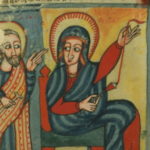 Christian Apocryphal Literature on Humanities Commons 8 years, 9 months ago
The image of Mary spinning thread in the group icon is from the late-seventeenth century Walters Ms. 36.10 (a Gondarine sensul depicting a number of scenes from the Protevangelium of James).
-
Eric Vanden Eykel created the group
Christian Apocryphal Literature on Humanities Commons 8 years, 9 months ago -

Jacqueline Vayntrub's profile was updated on Humanities Commons 8 years, 9 months ago
-
Eric Vanden Eykel's profile was updated on Humanities Commons 8 years, 9 months ago
-

simeon chavel changed their profile picture on Humanities Commons 8 years, 9 months ago
-
simeon chavel changed their profile picture on Humanities Commons 8 years, 9 months ago
-
simeon chavel's profile was updated on Humanities Commons 8 years, 9 months ago
-
Jacqueline Vayntrub's profile was updated on Humanities Commons 8 years, 9 months ago
-
Matthew Thiessen deposited Paul’s Argument against Gentile Circumcision in Romans 2:17–29 on Humanities Commons 8 years, 9 months ago
The majority of interpreters conclude that in Rom 2:17-29 Paul addresses an ethnic Jew. In contrast, Runar M. Thorsteinsson has argued recently that Paul addresses a gentile, specifically a gentile who has judaized and now thinks of himself as a Jew. This article provides further support for Thorsteinsson’s argument, arguing that Paul, contrary t…[Read more]
-
Matthew Thiessen deposited The Many for One or One for the Many: Reading Mark 10:45 in the Roman Empire on Humanities Commons 8 years, 9 months ago
Though the “many for one” political ideology was widespread in the first century CE, Mark 10:45 rejects this ideology. Instead, this type of rule is contrasted with Jesus’s own rule as a servant king, sacrificing himself (the one) for his followers (the many).
-
Matthew Thiessen's profile was updated on Humanities Commons 8 years, 9 months ago
-
Matthew Thiessen changed their profile picture on Humanities Commons 8 years, 9 months ago
- Load More