


-

Stephanie Grimes deposited Records Go Visual: Digitizing, Exhibiting, And Contextualizing Archives From The House Of Representatives in the group
 Digital Heritage on Humanities Commons 1 year, 10 months ago
In 2015 the Office of Art and Archives focused on adding more art and archival content to the History, Art & Archives website (http://history.house.gov/). The website is a collaborative effort: curators and archivists in the Office of Art and Archives and Office of the Historian staff work on and contribute content. The Office of Art and Archives…[Read more]
-
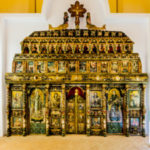
Ana Dumitran deposited Icoana Sfântului Ioan Botezătorul cu scene din viață de la Budești‑Josani in the group
 Digital Art History on Humanities Commons 2 years ago
In the history of old Romanian painting, the icon of Saint John the Baptist with scenes from his life from Budești‑Josani occupies a very important place due to its exceptional artistic quality, as well as the Slavonic inscription with the master’s signature and date. The inscription, in a very poor state of preservation, has already been part…[Read more]
-
Ana Dumitran deposited Le patriarche Sylvestre d’Antioche, son disciple spirituel Constantin César Dapóntes et l’histoire de leurs icônes in the group
Digital Art History on Humanities Commons 2 years agoThis study identified the icon of Virgin Moscovita and the icon of the Holy Mandylion, described in Konstantinos Dapontes’ writings, with the icon of the Virgin and the icon of the Holy Mandylion preserved in his family monastery Evangelistria in Skopelos island. We can now retrace the “biography”of these two artefacts, the history of their creat…[Read more]
-
Ana Dumitran deposited The Chronology of the Murals in the Râmeț Monastic Church (Alba County, Romania) Based on a Reevaluation of the Dating of the Narthex Inscription in the group
Digital Art History on Humanities Commons 2 years agoLa découverte d’une inscription slavonne dans le narthex de l’église du monastère de Râmeț (comté d’Alba) en 1966, sa relecture avec des moyens techniques spéciaux en 1978 et sa publication officielle en 1985 ont porté à l’attention des historiens le nom du peintre (Mihul du Criș-Blanc), le nom de l’évêque fondateur (archevêque Gélase),…[Read more]
-

Matthew Korpman deposited “Dan Shall Judge: The Danites and Iron Age Israel’s Connection with the Denyen Sea People,” Journal for the Study of the Old Testament 44.3 (2020): 490-499. in the group
Ancient Near East on Humanities Commons 2 years agoThe Tribe of Dan has always appeared to biblical scholars and archaeologists as something of an enigma. For decades, certain scholars, beginning with Yigael Yadin, have proposed a connection between the Denyen/Danaoi Sea People and the Danites of Ancient Israel, arguing that the former became the latter and were adopted into Israel at a later date…[Read more]
-
Matthew Korpman deposited “Source Criticism: Teaching the Documentary Hypothesis,” Didaktikos: Journal of Theological Education 3.3 (2019): 30-31. in the group
Ancient Near East on Humanities Commons 2 years agoA summary and review of a creative and neutral approach to teaching the Documentary Hypothesis to undergraduate students.
-

Lloyd Graham deposited Counterparts of ancient Egyptian maat in other cultures in the group
Ancient Near East on Humanities Commons 2 years agoThis paper surveys potential counterparts of the ancient Egyptian concept of mAat (maat) from other cultures and summarises such cross-cultural studies as have already been completed. Its scope ranges from antiquity to the present day and across Europe, Africa, the Near East, India, China, Australia and the Americas. Paradigms that appear to…[Read more]
-

Alicia Colson deposited NFTs, AI, Ethics, and Indigenous Peoples. in the group
Digital Art History on Humanities Commons 2 years agoThe article is published in the official Journal of The Institute of Science and Technology (ISSN 2040-1868)
-
Alicia Colson deposited Do not make snap decisions about what you are seeing: how digital analysis of the images from the Canadian Shield highlights the difficulties in classifying shapes in the group
Digital Art History on Humanities Commons 2 years agoThe act of classification has the widest implications for scholarship. Whatever the format, it involves the totality of our being. The use of our eyes indicates that decisions about whatever it is that we observe have already been made. Yet the interaction between the mechanical act of seeing and the mind or memory has rarely been registered. An…[Read more]
-
Alicia Colson deposited AI generated images, photography and visual documentary evidence as sources: Thoughts on Boris Eldagsen’s Image, well ‘photograph’. in the group
Digital Art History on Humanities Commons 2 years agoSome thoughts on Boris Eldagsen’s Image, well ‘photograph’, an AI generated image.
-
Alicia Colson deposited WHAT DO THESE SYMBOLS MEAN? A CRITICAL REVIEW OF THE IMAGES FOUND ON THE ROCKS OF THE CANADIAN SHIELD WITH SPECIFIC REFERENCE TO THE PICTOGRAPHS OF THE LAKE OF THE WOODS in the group
Digital Art History on Humanities Commons 2 years agoReview of the literature on pictograph sites in the Canadian Shield with specific reference to those found in the Lake of the Woods, in north-western Ontario, Canada.
-

Johannes Bernhardt deposited Creative Museum. Dokumentation und Manual in the group
Digital Heritage on Humanities Commons 2 years, 2 months agoThis booklet serves as documentation and manual for the app Creative Museum, the new participatory platform of the Badisches Landesmuseum. The goal of the app is to create a digital space for debate. Museum employees, experts and citizens are invited to get into conversation with each other and share their contributions on equal terms. The topics…[Read more]
-
Ana Dumitran deposited Russian Icons from Transylvania. Exhibition Catalogue in the group
Digital Art History on Humanities Commons 2 years, 2 months agoThis publication is part of the project “Ricontrans – Visual Culture, Piety and Propaganda. Transfer and Reception of Russian Religious Art in the Balkans and the Eastern Mediterranean (16th to Early 20th Century)”, funded from the European Research Council (erc) under the European Union’s Horizon 2020 research and innovation programme (grant…[Read more]
-

Julia Rhyder deposited Sonja Ammann, Katharina Pyschny, and Julia Rhyder, eds. Authorship and the Hebrew Bible. FAT 158. Tübingen: Mohr Siebeck, 2022. in the group
Ancient Near East on Humanities Commons 2 years, 3 months agoDoes “authorship” still have a place in the study of the Hebrew Bible? Historical criticism has long sought to uncover the human authors behind the biblical texts. But how might the “death of the author,” so forcefully declared by Roland Barthes over fifty years ago, change the contours of this search? This volume brings together leading experts…[Read more]
-
Julia Rhyder deposited Centralizing the Cult: The Holiness Legislation in Leviticus 17–26. FAT 134. Tübingen: Mohr Siebeck, 2019. in the group
Ancient Near East on Humanities Commons 2 years, 3 months agoThis work provides new insights into the relationship between the Holiness legislation in Leviticus 17–26 and processes of cultic centralization in the Persian period. The author departs from the classical theory that Leviticus 17–26 merely presume, with minor modifications, a concept of centralization articulated in Deuteronomy. She shows how Lev…[Read more]
-
Julia Rhyder deposited “Hellenizing Hanukkah: The Commemoration of Military Victory in the Books of the Maccabees.” Pages 92–109 in Collective Violence and Memory in the Ancient Mediterranean. Edited by S. Ammann, H. Bezold, S. Germany, and J. Rhyder. CHANE 135. Leuven: Brill in the group
Ancient Near East on Humanities Commons 2 years, 3 months agoEarly Jewish writings are replete with narratives of warfare and collective violence. Yet relatively little scholarly attention has been paid to how these accounts of violence affected the way Jews structured their festal calendar. This essay examines the festivals described in 1 and 2 Maccabees that serve to commemorate the most impressive m…[Read more]
-
Julia Rhyder deposited Sonja Ammann, Helge Bezold, Stephen Germany, and Julia Rhyder, eds. Collective Violence and Memory in the Ancient Mediterranean. CHANE 135. Leuven: Brill, 2023. in the group
Ancient Near East on Humanities Commons 2 years, 3 months agoThis Open Access volume reveals how violent pasts were constructed by ancient Mediterranean societies, the ideologies they served, and the socio-political processes and institutions they facilitated. Combining case studies from Anatolia, Egypt, Greece, Israel/Judah, and Rome, it moves beyond essentialist dichotomies such as “victors” and “va…[Read more]
-

Chris Alen Sula started the topic Cluster hire: Asst Professor, “Diverse Voices Creating Just Futures” (Pratt) in the discussion
Digital Art History on Humanities Commons 2 years, 3 months agoPlease see below for details about a tenure-track position in digital humanities in the History of Art & Design
*********
Pratt Institute invites applications for a cluster of five new tenure-track faculty positions at the level of Assistant Professor, focused on “Diverse Voices Creating Just Futures.” We seek applicants from a range of dis…[Read more]
-

Ellie Bennett deposited Using Word Embeddings for Identifying Emotions Relating to the Body in a Neo-Assyrian Corpus in the group
Ancient Near East on Humanities Commons 2 years, 3 months agoResearch into emotions is a developing field within Assyriology, and NLP tools for Akkadian texts offers new perspectives on the data. We use PMI-based word embeddings to explore the relationship between parts of the body and emotions. Using data downloaded from Oracc, we ask which parts of the body were semantically linked to emotions. We do this…[Read more]
-
Ellie Bennett deposited Beards as a Marker of Status during the Neo-Assyrian Period in the group
Ancient Near East on Humanities Commons 2 years, 3 months agoBeards were part of a visual matrix of expressing masculinity during the NeoAssyrian period (ca. 934–612 BCE). But masculinity does not exist in isolation and interacts with other aspects of identity. I will examine the beard as an indicator of masculine status during the Neo-Assyrian period. This will be done through investigating the visual a…[Read more]
- Load More
Open access, open source, open to all