


-
Flavia De Nicola deposited Equus infoelicitatis: analisi iconografica di una xilografia dell’ Hypnerotomachia Poliphili fra testo e immagine, xilografia n. 6 in the group
 Renaissance / Early Modern Studies on Humanities Commons 5 years, 2 months ago
The peculiar iconography of the winged horse surmounted by several puttos, as appears in the Hypnerotomachia Poliphili sixth woodcut, turns out to be unprecedented and enigmatic at a glance and it’s the result of the depth and complexity of the author’s concepts.
Considering the iconographic details of the sculptural group as well as the text sca…[Read more] -
Flavia De Nicola deposited Equus infoelicitatis: analisi iconografica di una xilografia dell’ Hypnerotomachia Poliphili fra testo e immagine, xilografia n. 6 in the group
 Italian Art Society on Humanities Commons 5 years, 2 months ago
The peculiar iconography of the winged horse surmounted by several puttos, as appears in the Hypnerotomachia Poliphili sixth woodcut, turns out to be unprecedented and enigmatic at a glance and it’s the result of the depth and complexity of the author’s concepts.
Considering the iconographic details of the sculptural group as well as the text sca…[Read more] -

Kathleen W. Peters deposited Sacred Views of Saint Francis: The Sacro Monte di Orta in the group
Renaissance / Early Modern Studies on Humanities Commons 5 years, 2 months agoOverlooking Lago di Orta in the foothills of the Northern Italian Alps, the Renaissance-era Sacro Monte di Orta (a UNESCO World Heritage site) is spectacle and hagiography, theme park and treatise. Sacro Monte di Orta is a sacred mountain complex that extolls the life of St. Francis of Assisi through fresco, statuary, and built environment.…[Read more]
-
Kathleen W. Peters deposited Sacred Views of Saint Francis: The Sacro Monte di Orta in the group
 Medieval Studies on Humanities Commons 5 years, 2 months ago
Overlooking Lago di Orta in the foothills of the Northern Italian Alps, the Renaissance-era Sacro Monte di Orta (a UNESCO World Heritage site) is spectacle and hagiography, theme park and treatise. Sacro Monte di Orta is a sacred mountain complex that extolls the life of St. Francis of Assisi through fresco, statuary, and built environment.…[Read more]
-
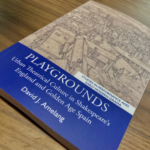
David Amelang deposited David J. Amelang, “A Day in the Life: The Performance of Playgoing in Early Modern Madrid and London” (Bulletin of the Comediantes 70.2, 2018), pp. 111-127 in the group
Renaissance / Early Modern Studies on Humanities Commons 5 years, 2 months agoGoing to the theater was one of the most distinctive-as well as conspicuous-cultural activities to take place regularly in early modern european cities. Precisely because so many people from all walks of life partook of this highly visible pastime, public theaters became spaces wherein social and cultural boundaries between spectators were easily…[Read more]
-
David Amelang deposited David J. Amelang, “’A Broken Voice’: Iconic Distress in Shakespeare’s Tragedies” (Anglia 137.1, 2019), pp. 33-52 in the group
 The Renaissance Society of America on Humanities Commons 5 years, 2 months ago
This article explores the change in dynamics between matter and style in Shakespeare’s way of depicting distress on the early modern stage. During his early years as a dramatist, Shakespeare wrote plays filled with violence and death, but language did not lose its composure at the sight of blood and destruction; it kept on marching to the beat o…[Read more]
-
David Amelang deposited David J. Amelang, “’A Broken Voice’: Iconic Distress in Shakespeare’s Tragedies” (Anglia 137.1, 2019), pp. 33-52 in the group
Renaissance / Early Modern Studies on Humanities Commons 5 years, 2 months agoThis article explores the change in dynamics between matter and style in Shakespeare’s way of depicting distress on the early modern stage. During his early years as a dramatist, Shakespeare wrote plays filled with violence and death, but language did not lose its composure at the sight of blood and destruction; it kept on marching to the beat o…[Read more]
-
David Amelang deposited David J. Amelang, “Playing Gender: Toward a Quantitative Comparison of Female Roles in Lope de Vega and Shakespeare” (Bulletin of the Comediantes 71.1-2, 2019), pp. 119-134 in the group
Renaissance / Early Modern Studies on Humanities Commons 5 years, 2 months agoOne of the major differences between the otherwise very similar commercial theatrical cultures of early modern Spain and England was that, whereas in England female roles were performed by young, cross-dressed boys, in Spain female performers were prominent in their industry. indeed, actresses in Spain played an active role in the creative process…[Read more]
-

Anna Dorofeeva deposited Visualizing codicologically and textually complex manuscripts in the group
Medieval Studies on Humanities Commons 5 years, 3 months agoThis article presents the collation map, a diagrammatic method for visually mapping the texts of complex medieval Western manuscripts against their material structures. Beginning with an overview of collation formulae – currently the most frequently used method of representing collation – the article argues that the collation map is a more use…[Read more]
-

Elisabeth Moreau deposited Libavius, Andreas in the group
 Renaissance Science and Medicine on Humanities Commons 5 years, 3 months ago
In the history of early modern science, the German physician Andreas Libavius (Halle, Saxony, c.1550–Coburg, Bavaria, 1616) is known for having promoted the institutionalization of alchemy in the academic sphere along with the creation of laboratories and instruments. Libavius was also remarkable for his extended network of scholarly friends and f…[Read more]
-
Yan Brailowsky deposited « La tête qui bondit » ou la décollation de Marie Stuart in the group
Renaissance / Early Modern Studies on Humanities Commons 5 years, 4 months agoMary Stuart’s Bouncing Head
Execution scenes reveal the links between the spectacular and the punitive (Michel Foucault), but they are difficult to stage, even more so when the topic is the decapitation of Mary Stuart, whose execution divided Catholics and Protestants, forcing playwrights to adopt several mediation strategies. Taking plays by J…[Read more] - Load More
Open access, open source, open to all