

A group for those interested in reading William Rowley’s The Birth of Merlin! Whether it’s your first or fiftieth time through the weird and wonderful world of this fabulous play, you are welcome here to discuss (asynchronously) with friends.
Act One
 Charlene Smith 5 years, 10 months ago
-
AuthorPosts
-
-
19 April 2020 at 2:34 pm EDT #30477
Act One! Just two quick scenes to introduce two of the three plots: the lovers plot with Cador, Constantia, Edwin, and Modestia, and the high/political plot with King Aurelius and Artesia. Of course, because it’s Rowley, we get some wonderful slippage between the two 🙂 We have yet to venture into the comic/low plot, starring Rowley’s self-insert Clown. That comes at the start of Act 2.
I was struck, re-reading Act One this weekend, by the parallel setup of the various betrothals: Donobert is established for us as a prudent matchmaker in Scene 1, and so his objections to the king’s betrothal in Scene 2 feel justified. His suspicions are also confirmed, of course, by Artesia’s aside threatening the Hermit’s life late in the scene. (Artesia is my favourite character and she does not disappoint on a re-read!)
Welcome to Act One. Reactions? Comments? Questions?
-
19 April 2020 at 8:33 pm EDT #30479
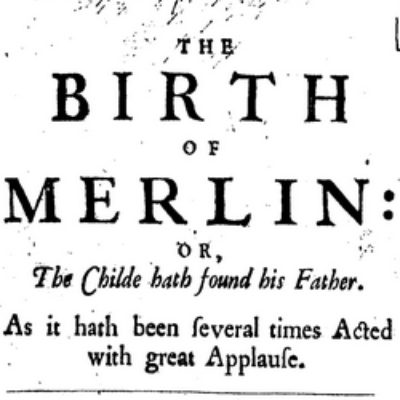
I’ll have some comments on Act 1 soon, but, before we start, can I get some practical stuff out of the way? This play was originally called The Child hath Found his Father and was written in 1622 for Prince Charles’s Men, who were then performing at the Curtain in Shoreditch.
I’m making a special point of saying this because the information was discovered as recently as 1996, and thus doesn’t appear in many reference books. The discoverer was N.W. Bawcutt, who found some lost entries from Malone’s transcription of Sir Henry Herbert’s office-book. The entry in question reads:
The Childe hath founde his Father, for perusing and allowing of a New Play, acted by the Princes Servants at the Curtayne, 1622 1li
This is all quite important. The date is significant because it makes impossible the claim on the title page of the 1662 Quarto that Shakespeare was Rowley’s collaborator. It also tells us that it was probably written after Middleton’s Hengist, King of Kent (c.1620), whose plot it overlaps. From the reference to the Curtain, we learn it was written for an outdoor public theatre. And the title is interesting, focusing more on the quest for the father than on the birth.
That is all! Proceed!
Sources:
- N.W. Bawcutt, “New Entries from the Office-Book of Sir Henry Herbert.” English Literary Renaissance 26, no. 1 (1996): 155-66. http://www.jstor.org/stable/43447513
- N.W. Bawcutt, The Control and Censorship of Caroline Drama (OUP, 1996), 136.
-
This reply was modified 5 years, 11 months ago by
David Nicol.
-
21 April 2020 at 6:43 am EDT #30513
Thanks for that important context, Dave — I was trying to figure out the best space to highlight the suspicious attribution on the title-page!
Really glad so many of you are as intrigued by Artesia and her epic entrance as I am. It feels like we get a lot more women and kinds of women in these first two scenes than in most plays I can think of? We have Constantia as a kind of archetypal lover, Modestia resisting that and being framed as pious, and Artesia as seductive but evil. And we’ve yet to meet Joan Goe-too’t! Interesting to imagine the range of the original boy players involved…
-
This reply was modified 5 years, 11 months ago by
 Nora J Williams.
-
This reply was modified 5 years, 11 months ago by
-
20 April 2020 at 1:45 am EDT #30481
I’ve never read this, and so am finding it great fun (and surprisingly rare) to read an EM play without knowing in advance what is going to happen.
I love that Modestia is given a soliloquy, and a deeply philosophical reason, to desire a spiritual path for herself, in preference to marriage.
That is one hell of an entrance Artesia gets, and I wish I could see how it would have been handled in the staging. She is obviously framed to be dazzling, heralded by cornets and flanked by Saxon Lords, and instantly rendering the King incapable of coherent thought – how would the original production have made her look in order to signal such impressiveness? If anyone knows something about how the C17th English conceived of what would make Saxons distinctive in appearance, I would be very interested to hear it. I realise that my sense of the Saxon represented in later British art is pure Victoriana!
-
20 April 2020 at 7:51 am EDT #30490
Hi everyone. Wanted to open by saying that I’m already enjoying reading this play one act at a time and really considering what is presented in each one. Not sure I’ve ever done that.
First thing I wanted to say is how much I got out of reading the dramatis personae, particularly the intriguing role of the ‘little antic spirit’ and also the character babe of Joan Goe-Too’t (if I remember correctly)!
The scene that most interested me from a performance point of view, similarly to Anna, was Artermesia’s entrance (‘a female orator’ – shock horror! How might *that* line be delivered?). I was wondering particularly about the performance tone and character reactions to the o’er-hasty wooing. It seems hilarious as a modern reader but would it actually be quite shocking for the original audience? There’s a very similar scene in The Maid of Honour (albeit gender-reversed) so I wonder if these plays are talking to each other or whether there are more examples?
Look forward to seeing the development of what is sure to be a happy marriage!
Ellie
-
20 April 2020 at 4:51 pm EDT #30502
It was interesting to read Act One, because when I read this play before I was mostly interested in the Clown, so I tended to skim-read the serious bits. But they’re actually fun! Artesia is a great role; she’s reminding me of Tamora in Titus Andronicus.
Modesta is interesting. She makes me think of the other holy virgins who reject marriage in the plays of this period. St Winifred is prominent in Rowley’s A Shoemaker a Gentleman (c.1618), and there’s also Dorothea in The Virgin Martyr (c.1620) and Camiola in The Maid of Honour (whose date is debated but sometimes thought to be 1621). In those plays, Winifred and Dorothea are both martyred in horrid fashion, but Camiola gets ends the play by getting her to a nunnery, rejecting her suitors. Which will be Modesta’s fate??
-
This reply was modified 5 years, 11 months ago by
-
This reply was modified 5 years, 11 months ago by
-
21 April 2020 at 1:55 am EDT #30512
Hi everyone. Wanted to open by saying that I’m already enjoying reading this play one act at a time and really considering what is presented in each one. Not sure I’ve ever done that.
First thing I wanted to say is how much I got out of reading the dramatis personae, particularly the intriguing role of the ‘little antic spirit’ and also the character name of Joan Goe-Too’t (if I remember correctly)!
The scene that most interested me from a performance point of view, similarly to Anna, was Artesia’s entrance (‘a female orator’ – shock horror! How might *that* line be delivered?). I was wondering particularly about the performance tone and character reactions to the o’er-hasty wooing. It seems hilarious as a modern reader but would it actually be quite shocking for the original audience? There’s a very similar scene in The Maid of Honour (albeit gender-reversed) so I wonder if these plays are talking to each other or whether there are more examples? Look forward to seeing the development of what is sure to be a happy marriage!
-
21 April 2020 at 6:45 am EDT #30514
[For interest, I’m reading this in the 1908 Shakespeare Apocrypha; will be interested to see if any of C.F. Tucker Brooke’s editorial idiosyncrasies show themselves, though he’s usually pretty diplomatic.]
One thing I appreciate is how straightforward the opening is. The deference to Constantia’s wishes; the banter about ‘He is a man, I hope.’ / ‘That’s in the trial’ (I like to imagine Cador standing by awkwardly); I kept expecting a family squabble, and the low stakes are something of a relief. And I like the structural imbalance that almost always gives Modestia a longer riposte to Edwin than his initial approach, even before her soliloquy.
I’m from near Chester, so one of the things that jumps out at me straightaway is the significance of that location on the Welsh border (and of course, we’re up in Green Knight territory too). Right from the start, the evocation of the hermit emerging in that liminal area between ‘Brittain’ and ‘(Welsh) Brittain’ (as Tucker Brooke’s dramatis personae clarifies) sets up a play invested in those slippery, fluid spaces.
-
21 April 2020 at 8:06 am EDT #30518
In relation to David’s point about Artesia being like Tamora, I’d also compare Estrild from Locrine. Edwin’s ‘She was woo’d afore she came, sure’ is a great cynical line, and I love these set-ups where everyone onstage apart from one person (who is the most powerful) can see exactly what’s going on.
Picking up on Anna’s comment about Aurelius being rendered incapable of thought, I was enjoying how this is represented in his speech. The page of the quarto is a mess, and Tucker Brooke’s attempts at punctuation and lineation were catching my eye, especially where he’s almost broken his em-dash key with overuse:
Aurel. True, thou art old: how soon we do forget
Our own defects! Fair damsel, — oh, my tongue
Turns Traitor, and will betray my heart — sister to
Our enemy: — ‘sdeath, her beauty mazes me,
I cannot speak if I but look on her. —
What’s that we did conclude?Especially combined with the enjambment, that fragmented speech is such a beautiful textual performance of distraction. And then there’s a fragmented verse line as Donobert loyally concludes his king’s last half-line:
What’s that we did conclude?
Dono. This, Royal Lord —
Aurel. Pish, thou canst not utter it: —Aurelius’s new part-line smashes across Donobert’s attempt to regularise his king’s speech, perhaps? I like the fact that Tucker Brooke’s lineation creates a really uneven split line that contributes to the chaos.
-
21 April 2020 at 2:20 pm EDT #30542
Was anyone else reminded of Love’s Labour’s Lost? Sort of a comparison by inversion–since obviously Artesia succeeds more quickly at getting a Welcome and makes the opposite bargain of LLL’s Princess–but the beginning of the scene sets up an agreement of lords that immediately meets the (feminine) agent of its undoing.
I’m also curious about the Modestia/Hermit exchange. It doesn’t seem uncommon to me to see religious/spiritual vocation rendered in the language of romance, but she asks after him during her ostensibly “romantic” scene with Edwin, and then enters the policy scene to profess to him her love (of virtue! ahem!) which interestingly transposes her desires across the A/B plot. This is my first reading of the play so I have no idea what the outcome is for Modestia, but I imagine that a lot rests on performance choices in her scenes. There is potential for humor in sexual tension with the Hermit, but I suspect she is meant to be more of a Marina, whose modesty and chastity is so excessive that it converts all those around her. Still, raises questions for me about asexuality/celibacy vs aromanticism; especially when put in contrast with Artesia (the seductive but evil archetype, as Nora points out).
Looking forward to Act II!
-
22 April 2020 at 12:23 pm EDT #30576
Pete, thank you for bringin up the messy quarto — it’s actually one of my favourite things about this play, and somehow I feel like the hot mess of its 1662 printing matches the wackiness of the play’s contents. I also like the confusion it creates around asides, and that Aurelius speech you’ve quoted is a great example. What’s everyone hearing? What’s Artesia hearing? What’s only heard by the courtiers? What’s just for the audience?
Picking up Sawyer’s points about Modestia, I feel like Rowley perhaps is a bit more willing to let characters weave between plots than many other playwrights of this period? (Tho maybe Dave can correct me on that?). Certainly in this play there’s a fair amount of back-and-forth, especially once Merlin gets involved, and I love Sawyer’s point about the way Modestia is resisting both the romantic narrative her father and Edwin expect, *and* the generic constraints of the scenes she’s in–she quite deliberately disrupts both the ‘lovers’ plot and the ‘political’ plot, as you say. Something really interesting to keep paying attention to as the play goes on, I think…
-
23 April 2020 at 5:20 pm EDT #30641
Finally got round to reading this. I’m getting a lot of King Lear but it’s of course also very obviously not like Lear and I like its tonal ambiguities. I’m registering Lear partly because, despite my aspirations to the contrary, I simply know Shakespeare’s plays better than I do those of other writers (even if I like to think I’m fairly well-versed in early modern theatrical culture). So, the Lear-ishness jumps out and overrides other reference points (though I take completely the points David, Ellie, and Pete have made about The Maid of Honour, Locrine etc.) One thing I’m getting from an intertheatrical connection with Lear is the opening emphasis on a loquacious woman, when Shakespeare gives us a woman who is famously unwilling to speak. Auerlius has got a speech about humanity that gave me Lear vibes too (though not Lear opening scene vibes). But this very clearly isn’t the Lear universe, and I love that.
I also wanted to pick up on the point Pete makes about Aurelius’ speech. I agree it’s rich with theatrical possibilities: a lovely gift for an actor. I like to think of Middleton (Rowley’s collaborator, elsewhere, of course) as the great artist of the aside (Nora has written beautifully about his asides in The Changeling). There’s something Middletonian, I think, about this speech. I think of Middleton’s asides as being really supple and inventive. He loves to play with the form. David mentioned that this play is close in date and setting, to Middleton’s Hengist. I haven’t read Hengist for a while, but he’s doing some lovely things with asides there too, as I recall. What are Rowley’s asides like, people who know Rowley’s work better?
-
24 April 2020 at 1:11 am EDT #30648
This might just be because I read it recently and it’s on my mind, but the introduction of Artesia is giving me “Friar Bacon and Friar Bungay” vibes. Artesia has a kind of magical power over Aurelius in a way that echoes both Friar Bacon’s magical silencing of his rival (and do I vaguely recall that there’s a magical context later in this play?), Margaret’s charming beauty that enthralls Lacy–but more nefarious.
I can think of examples of love inspiring eloquence (Viola’s willow cabin?), but are there other examples of love resulting in the failure of speech? I feel like there must be but can’t think of any off the top of my head.
-
24 April 2020 at 11:32 am EDT #30665
Eoin, that point you make about the similarities with Middleton’s asides is one that (from memory???) Dave explores in his book on Middleton & Rowley’s collaborations — he makes a very convincing argument that their collaborative work influences the way that they write as solo playwrights, too, with each picking up some stylistic bits and pieces from the other. Dave may want to say something more specific about that in relation to Merlin?
Failure of speech is a really interesting thread to pick up, Andrew! I don’t want to spoil anything, but that will come back, in other contexts and with magical helpers, in later acts of the play 🙂
-
25 April 2020 at 8:11 am EDT #30690
I’m gonna be honest, I never mentioned asides in my book! I’m not aware (though admittedly have not thought much about it) of Rowley having any particularly unusual uses of asides in his other plays beyond The Changeling.
Which leads to the interesting question of authorship! I would love it if we could think more about who wrote this play as we read on. Does it read like a collaborative play? Do you have any theories about whether Rowley had a co-author?
Studies of the authorship of this play have been muddied in the past by (a) the Shakespeare attribution on the title page, which sucked up a lot of energy, and (b) uncertainty over its date. Now that we know, thanks to N.W. Bawcutt, that the play was written in 1622, the Shakespeare attribution evaporates but other candidates appear more likely.
Consider Rowley’s other collaborations around this time:
- 1620: The World Tossed at Tennis by Middleton & Rowley
- 1621: The Witch of Edmonton by Dekker, Ford & Rowley
- 1622: The Changeling by Middleton & Rowley
- 1623: The Spanish Gypsy by Middleton, Rowley, Dekker, & Ford
- 1624: A Cure for a Cuckold by Rowley, Heywood and Webster
- 1624: Keep the Widow Waking by Rowley, Dekker, Ford and Webster
So, Middletonian asides are most interesting. And as you read, look out for hints of Dekker, Ford, Heywood and Webster. This is relatively unexplored scholarly territory and who know what we may find?!
-
25 April 2020 at 4:29 pm EDT #30698
Hi friends,
Well this is totally delightful! A couple queries here after act one from a few different vantage-points. I’m interested to know your thoughts!
Thematic. There seem to be some parallels concerning counsel and consent. Three women in act one are betrothed, but all are contracted by a double negative. As the Saxon Lady says, “I were no woman to deny,” is not a signal of consent, but an acknowledgement that they are not in a place to deny ([A3-A4, B1]). This seems in some ways analogous to the lords offering counsel to their king not to marry “a Pagan, an Idolator” ([B1v]), by Cador, Edwin, and then the Hermit. A marriage to a non-English woman outside the consent of peers of the realm smacks something of H6 and Titus, among others no doubt some of you have ideas. There seems to be something to the line “Both States in Peace and Love.”
Dramaturgical. For a play that forecasts Merlin, this was surprising low-tech to me for the first act. There is some description of the battle—“holy man armed with cross and staff, went smiling on” in to battle where above his head “appeared such brightness”—but only by reportage and not display. A letter and a book are called for, perhaps the most basic of properties, and only one call for a trumpet flourish. This play thus far is very chatty, but otherwise very quiet in comparison to the “English history play” genre broadly—quite the opposite of what I was expecting! I wonder if this is to whet our whistle in anticipation of displays to come?
Likewise, while the Saxon soldiers seem afeared at the hermit/Merlin entrance, this is maybe not necessarily shock at his personal appearance? Do we envision something comely as a religious hermit or prophet of a Judeo-Christian imaginary, or something more wild man of the woods? If the former, is this a moment of theatrical deflation wherein the personal appearance of Merlin doesn’t live up to the battlefield performance? Or is a humble, Protestant display of simple garb the point? I am curious if others have thoughts about signals of anticipation and to what extent those are made good on or deflated (perhaps in the vein of the medieval vice tradition of entering past the halfway mark)?
Paratextual. Having started reading after I saw the compelling thoughts about asides, I tried to attend to them, particularly as they don’t seem to be consistently marked via mise-en-page. (As best as I can tell anyway? Thoughts on this?) I am having some difficulty envisioning the negotiation of space on stage, where different factions of peers (as opposed to ladies and saxons) are being managed in terms of implicit blocking, how vast this royal hall is envisioned to be within the world of the play, &c. Asides, in demarcating public and private speech, I often find a handy tool to see where the invisible velvet rope stanchions are for this community within the play.
The possibility for asides seems to be particular, again, to the moments of marriage proposals and courtly dissent. None of the comments uttered (the sex-appeal of a woman, the dissent from a lord) is ultimately covert or kept the subject of the statement. To the former, they are even commented on later as “childish compliments” ([B1v]). For blocking purposes, my preference would be to treat these as aside, but I wonder what’s gained by reading them not as cordoned speech? Perhaps that would make available a reading where the brutishness of this Arthurian court is rhetorically marked? Something vulgar in not containing speech we would typically consider private?
And I see a prosthetic belly is called for at the top of the next act! Sara B.T. Thiel’s chapter, “’Cushion come forth’: Materializing pregnancy on the Stuart Stage,” from Stage Matters: Props, Bodies, and Space in Shakespearean Performance (Farleigh Dickinson UP 2018) might be of interest to some in this regard.
Cheers!
ET
-
26 April 2020 at 8:13 am EDT #30703
Coming to this late, as juggling work and the great homeschooling experiment has been really challenging this week… but very glad that I stole a bit of time for this in the end!
The wonderful weirdness obviously starts with the dramatis personae as several people have already noted. I love the fact that we have such straightforward descriptions of roles (this or that earl, their son or daughter etc.) as well as some quirkier names (Sir Nichodemus Nothing, Joan Goe-Too’t), and then in the middle of that list the incredibly understated: The Devil, Father of Merlin. Presumably this wouldn’t have been such a shock to an EM readership more familiar with this story of Merlin’s origins than I am, but I’m now intrigued to see how the more obviously fantastical elements are going to be combined with the courtly ones as the play goes on.
Within Act 1 itself, the thing that struck me most was the reaction of Aurelius to Artesia, which has been picked up on by Pete, Eoin, Nora and others. The question of who can hear what, and the ambiguity over whether a line or part thereof might be a true aside, or something that is produced as rushed or muted but still audible to others – whether accidentally or by design – made me think of various bits from Lyly’s Galatea. I completely agree that the “Oops, did I say that out loud?” possibilities would be wonderful to explore in rehearsals or the classroom. (I must also check out what Nora’s written about asides in the The Changeling!)
The other thing that struck me about this bit was that it brought to my mind other examples in which it is female rulers who are verbally wrestling with how their feelings and desires are interfering with the performance of their role as figure of authority… immediately I thought of Dido, Queen of Carthage, and Quisara in The Island Princess. In the intro to her fantastic edition of the latter play, Clare McManus talks about how, in such scenes, Fletcher “examines the construct of feminine changeability and the protean nature of the early modern player” (46) – I’m still trying to organise my thoughts about that idea in relation to this scene with Aurelius and Artesia, but already there’s a lot this play to be explored!
-
26 April 2020 at 7:41 pm EDT #30710
Oh, these comments are fascinating! I know we’re about to move on to Act Two, but wanted to add a few thoughts. (Also, Nora, I applaud your pronunciation on Artesia!)
Thanks for the note about the play’s date, Dave; I was thinking about Hengist and the representation of the Saxons–in particular, the onstage spectacle that allows for distinctly separate but overlapping conversations. I was struck here by Gloster’s pronouncement, “he meanes to marry her” only after Aurelius has proposed to Artesia, she has accepted, and Aurelius has pronounced, “Live, then, a queen in Brittain”–I kept wondering who hears what, and when. This observation seems entirely in keeping with many of the earlier observations about asides and broken speech; I’m interested in how the (many!) characters onstage are unified or fractured into “onstage audience” in the temporality of response to a proclamation or spectacle. I also kept thinking about Fletcher and Massinger’s The Prophetess, also from 1622 (I think?), and also invested in spectacular acts of power and instant compulsion.
Relatedly, I was struck by the emphasis on time in relation to theatrical temporality. The play opens with Cador’s “long suit” and Donobert’s reassurance of the “opportunity” of “Time” and then urging to “make haste to end” the love. We know that Artesia is Bad News because Aurelius falls for her so swiftly, after all the metaphors of disease/cure/recovery that take time and are devastating if prematurely concluded, and after the blunt reminder that a 30-day truce is enough time to rebuild the strength of an army. But I think it’s really interesting that Aurelius’s response to Donobert’s caution is premised upon a kind of recognition of psychological projection: you’re old, and you just wish you had a similar chance of winning her. If the counselors to the king fear that he is too hasty in suddenly proposing marriage to the enemy, the king’s response is also logical, because he frames marriage as a way of securing peace forever. The burden of timing is on the women: if Modestia’s deferral sets up the possibility that virginity is an infinite frustration of one man’s desires, Artesia’s too-hasty capitulation to marriage demonstrates that she is suspect, as if Aurelius has no time to struggle with and master his longing. I’m interested in the pace of this play–the suddenness of entrances and alliances, in contrast with the moments that linger, like Modestia’s long soliloquy (and Sawyer, your evocation of the range of “love” in her speech is really apt, perhaps even producing the sense that Modestia’s response to the Hermit is a structural parallel to Aurelius’s response to Artesia).
-
26 April 2020 at 9:18 pm EDT #30712
*emendation: Nora, I obviously meant to applaud your *pronouncement* on Artesia’s awesomeness! Next time I will try to attend more carefully to the auto-correct…
-
-
22 May 2020 at 1:18 pm EDT #31497
Thanks for these great comments. I’m coming in. on the last day of the project!
Already fascinated in Act One, by much of what has been mentioned, particularly the introductions of three seemingly important female characters so early. I too caught that Modestia gets a soliloquy in the first scene, and when reading it, I was compelled to speak it out loud. As an actor, I find it reads smoothly and I feel the performance potential — a mark of good writing.
I’m interested in everyone’s initial impression of Artesia being Bad. I was inclined to like her (or at least be on her side) from the get-go due to the sexist remark that accompanies her entrance. Aurelius instant love reminded me of A King and No King, perhaps not an auspicious comparison… But it does make you think about performance and what a production would want to signify to the audience and how about who to trust…
-
-
AuthorPosts











- You must be logged in to reply to this topic.