

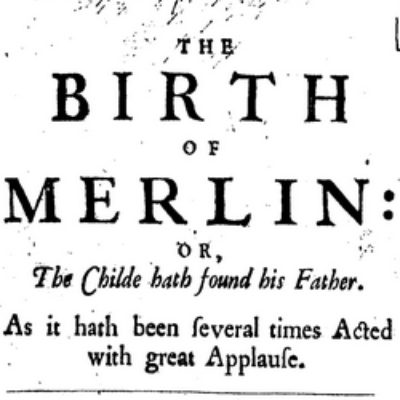
A group for those interested in reading William Rowley’s The Birth of Merlin! Whether it’s your first or fiftieth time through the weird and wonderful world of this fabulous play, you are welcome here to discuss (asynchronously) with friends.
Act Four
 Anna Kamaralli 5 years, 10 months ago
-
AuthorPosts
-
-
11 May 2020 at 4:53 am EDT #31171
Wow! Act Four already!!
The fun continues with our second magic battle (prophecy battle?) and one of my favourite speeches and stage directions in all of early modern drama:
MERLIN: Hast thou such leisure to enquire my fate,
And let thine own hang careless over thee?
Knowst thou what pendelous mischief roofs thy head,
How fatal, and how sudden?[…]
[A stone falls and kills Proximus.]
Also, DRAGONS! 4.1 is one of the most memorable scenes in the play for me, probably because I’m fascinated by the staging problems and possibilities of 1) a guy being killed by a falling rock and 2) a dragon battle?!
We also get more of Edol’s hot-headedness in this act. I love his re-entrance at the end of 4.2, where he enters on Vortiger and Uter fighting: ‘What, stand you talking?’ His frustration with the prince brings some levity to the battle scene, and I’m reminded of some more recent battle scenes in things like Marvel or James Bond movies that pull this same gag (Monday brain can’t think of a specific example right now, but I’m sure someone else will have it!).
And of course, the climax of Act 4 is Prince Uter becomeing Uter-Pendragon, and the setup of Merlin’s legendary relationship with him and his son.
THUNDER. Act Four!
-
This topic was modified 5 years, 10 months ago by
 Nora J Williams. Reason: typos
-
This topic was modified 5 years, 10 months ago by
-
11 May 2020 at 6:38 am EDT #31176
Genuine live footage of Proximus.
-
11 May 2020 at 6:43 am EDT #31178
Also strong Han Sol0-chasing-stormtroopers energy to ‘Enter Edol, driving all Vortiger’s Force before him‘.
-
11 May 2020 at 6:51 am EDT #31179
To give some slightly more serious thoughts, what I take away from Act IV is just how important the Clown is. This is the most conventionally Arthurian material so far – it’s telling the oft-retold story of the dragons and the castle, Merlin’s early prophecies, and the promise of Uter’s line. With the subplots and the Devil sidelined, the material has potential to be quite po-faced, especially in the long prophetic scenes of Merlin. So, aside from the absolute hilarious stone gag (I love imagining how that might be staged), the Clown has such an important role in keeping things interesting and light here, particularly in the long scene of him gagged and trying to interrupt. It’s a beautifully subversive scene, in which it’s easy to imagine everyone onstage gazing portentously into the middle distance, all while the Clown gurns and ‘hmms’ his thoughts to himself.
-
11 May 2020 at 11:16 am EDT #31181
So true, Pete! That scene always makes me think about the role of improvisation for clowns, too: my sense is that we can’t assume the Clown is only interrupting Merlin with his hums as scripted? And what else might he be up to in his bid to get attention?
-
11 May 2020 at 6:28 pm EDT #31202
So many staging challenges!
- In his Catalogue, Martin Wiggins points out that since the dragons are able to stop and start fighting on cue, they are probably performed by actors in costume.
- Sadly, Wiggins has nothing to say about the stone that kills Proximus, which is quite baffling; I will say that in Day, Rowley and Wilkins’ The Travels of the Three English Brothers there’s a scene where people are being stoned with rocks, so non-lethal prop stones may have been a thing.
- And there’s a blazing star too! I suspect it was a banner, rather than a firework, because the characters discuss its details for so long.
Although there’s still loads of fun stuff here, I can’t help thinking this is where the play starts to lose something. As a big fan of Rowley’s clowns, I do agree with Pete’s point that he keeps things light-hearted during the prophecy scene, but I must confess to being disappointed with what happens to the Clown in this act (and, SPOILER it gets worse in Act 5). He is no longer integral to the plot, but rather an appendage. In her 1991 edition, Joanna Udall argues that he’s a late addition to already-existing scenes: “The role of the Clown decreases in importance as Merlin becomes a public figure. […] He interrupts the serious business with his comments, but no sallies of wit are thereby engendered; in fact, he is ignored. […] If the Clown was a later addition in these scenes, it could account for his re-entry in IV.i and his subsequent abrupt dismissal (no reason given), and for the necessity of keeping him quiet in IV.v.” Of course, this raises all sorts of questions about what this play is (she suspects it’s a rewrite of an older play; but perhaps Rowley is hastily inserting his own role into an act written by someone else). What do others think of this?
And what do you think of Joan’s sudden transformation into a morality play heroine who speaks in blank verse and laments her pride? She even calls herself a peacock with black legs (reminding us of the devil-gallant with his cloven feet).
-
12 May 2020 at 1:59 am EDT #31206
Anna – just a right-click copy-and-paste worked for me!
David – love this: ‘In his Catalogue, Martin Wiggins points out that since the dragons are able to stop and start fighting on cue, they are probably performed by actors in costume.’ And there was me thinking they’d trained real dragons (young ones of course) – maybe they used those in court performance? 😉
I disagree, though, about the ‘suddenness’ of Joan’s transformation. I’m thinking back to my comments on Act 3, where Joan was already speaking blank verse even in two-way conversation with her prose-speaking brother. In this sense, one of the things I like is the consistency of the dynamic – it feels to me that Joan is always trying to be in a more serious romance that her brother is bathetically undermining, and (as was really clear in the Read Not Dead production) Merlin’s arrival is key in overtly intervening in that dynamic to bring out the more sincere plot – he tells his mother to ‘Speak freely’ in 4.1, and shuts his uncle up in 4.5. I wrote a piece a few years ago about the ways in which early modern dramatists use magician figures as author proxies, in that their less overtly spectacular interventions are so often rooted in deciding who gets to speak or ensuring the next plot point happens, and Birth of Merlin is another great exemplar.
-
12 May 2020 at 5:16 am EDT #31208
More beard reflections. I’m sorry – but Merlin’s beard is mentioned 4 or 5 times in 4.1., it’s clearly important! It becomes evident in this scene that his beard is too manly for his stature I think – the Gentlemen call him a “small gentleman” for instance, so there appears to be a mismatch between his height and his hair. It strikes me that there are all kinds of masculinity and lineage issues going on in the play, and especially in this act, with its usurpations, insurrections, and rebel alliances, and its overarching concern with how to reinstall a “lawful king”. At the same time, the questions over Merlin’s paternity continue and it seems to me that his beard – which should be a natural inheritance from father to son, like property, or money – becomes emblematic of the topsy-turvy manliness in the play. Without a lawful father, Merlin displays an unlawful beard, symptomatic of a wisdom which belies his years, and gesturing towards the disordered manliness of the Devil himself.
Also, it all got a bit GoT in this act didn’t it? The thought of staging this play is actually a bit terrifying – I don’t see how it can be anything other than comic. I wonder if Phil Butterworth’s article “Late Medieval Performing Dragons” contains anything helpful for staging these ones? I’ve not got round to reading it yet. Incidentally, comets are often described as having ‘beards’ in early modern texts. Just saying.
-
12 May 2020 at 10:05 am EDT #31210
Pete, thanks for those fantastic suggestions about the Clown/Joan/Merlin relationship. Love the idea that it’s kind of a meta battle over what kind of play this is.
Anything that can help me like Acts 4 and 5 more is very gratefully received!
-
12 May 2020 at 10:09 am EDT #31211
Oh! And Pete, I love your point that magicians can be author-proxies. This is really interesting given that Rowley plays the Clown. If you’re right, he’s kind of fighting with himself. Shutting himself up.
Or if the play is a collaboration, maybe the Clown is Rowley and Merlin is Webster???
-
17 May 2020 at 8:39 pm EDT #31361
Alas, some aspect of my system absolutely refuses to let me post a picture, so instead of a witty, thowaway visual I am forced to included a laboured attachment, that hopefully is still worth a laugh.
I am completely staggered in this play by how they chose to use a pair of nubile ingénues. I kept expecting them to turn up again and have some integrated purpose for the plot. I mean, I’m impressed by the choice to diverge so far from formula, but I’m really wishing I had access to the conversation where that was the direction decided on. “So… those two romances we set up, what if we… not?”
Attachments:
You must be logged in to view attached files.
-
-
AuthorPosts



- You must be logged in to reply to this topic.