

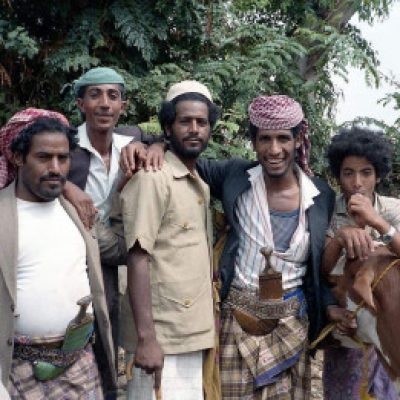

The Semitic languages are a group of related languages spoken across North and East Africa and the Arabian Peninsula, and one of the major language groups that descended from the larger family of Afroasiatic languages.
Files List
-
 The phonology and micro-typology of Arabic R
The R sound exhibits considerable variability both across and within Arabic dialects; one that covers place and manner of articulation, as well as the notorious emphatic-plain distinction. Some R phones are in contrastive distribution, while others are contextually conditioned or free variants. This article aims to establish the underlying R phonemes in the spoken varieties of Arabic, evidence of which is sought in R’s dialect-specific phonological behavior: in minimal pair contrasts, distributional phenomena, loanword phonology, and phonological processes that target or are triggered by R. Investigation of such evidence reveals four major patterns based on the nature and number of R phonemes, consequently classifying Arabic dialects into four types: the split-R dialects (primarily Maghrebi and Egyptian dialect groups), the emphatic-R dialects (the Levantine group), the plain-R dialects (the Gulf group together with most peripheral dialects), and the uvular-R dialects (the qeltu-dialects of Mesopotamia).
-
The Ancient Languages of Syria Palestine and Arabia
In the following pages, the reader will discover what is, in effect, a linguistic description of all known ancient languages. Never before in the history of language study has such a collection appeared within the covers of a single work. This volume brings to student and to scholar convenient, systematic presentations of grammars which, in the best of cases, were heretofore accessible only by consulting multiple sources, and which in all too many instances could only be retrieved from scattered, out-of-the-way, disparate treatments. For some languages, the only existing comprehensive grammatical description is to be found herein.
-
Bibliography of the Modern South Arabian languages
Initial compilation of this bibliography was done by the investigators of the Leverhulme Trustfunded Documentation and Ethnolinguistic Analysis of Modern South Arabian team (Watson, Morris & Eades), and from 2014 by Watson and Morris in collaboration with the people we thank at the end.
-
Proto-Modern South Arabian Vowels – A First Approximation
All Modern South Arabian languages possess large amounts of Arabic loanwords. Sometimes they can be identified by irregular consonant correspondences, such as /s/ corresponding to Arabic /s/ going back to Proto-Semitic */š/, which yields /š/ or /h/ in Modern South Arabian. In general, however, it is at the current state of knowledge not possible to reliably recognize loans. To minimize the danger of deforming the reconstruction by words that entered Modern South Arabian languages after they split, we will only consider words which either appear to have no cognate in Arabic, or also have a cognate outside of Arabic
-
Mehri and Hobyot spoken in Oman and in Yemen
In the South of the Arabian Peninsula in the Sultanate of Oman and in the Republic of the Yemen, live about 200,000 Arabs whose maternal tongue is not Arabic but one of the six socalled Modern South Arabian Languages (= MSAL).1 Mehri, Harsusi [ħarsūsi], Bathari [baṭħari], Hobyot [hōbyyt], Jibbali [ǧibbāli],2 and SoqoTri [sḳʌ́ṭri]. Only Mehri and Hobyot are spoken in the two countries. Except Soqotri spoken only in the Yemenite islands of Soqoṭra, ‘Abd-el-Kūri and Samħa, all others are spoken in Oman.
-
The Modern South Arabian Languages
In the South of the Arabian Peninsula, in the Republic of the Yemen and in the Sultanate of Oman, live some 200,000 Arabs whose maternal language is not Arabic but one of the socalled Modern South Arabian Languagues (MSAL). This designation is very inconvenient because of the consequent ambiguity, but a more appropriate solution has not been found so far. Although there exists a very close relationship with other languages of the same Western South Semitic group, the MSAL are different enough from Arabic to make intercomprehension impossible between speakers of any of the MSAL and Arabic speakers.
-
Ethiosemitic languages: Classifications and classification determinants
The present study addresses three concerns: (1) presents the areal classification of Ethiosemitic languages; (2) identifies major determinants of the distance among the languages; (3) challenges previous genealogical classifications of Ethiosemitic languages. To address these objectives, cluster analyses were performed on randomly selected 147 word lists. Multidimensional scaling was employed for the cluster validation. The cluster analyses performed on the phonetic and lexical distance matrices show that Ethiosemitic languages can be classified into six major groups: {Chaha, Gura, Gumer, Ezha, Mesqan, Muher}, {Amharic, Argobba}, {Endegagn, Inor, Gyeto}, {Wolane, Silt’e, Zay}, {Dobbi, Kistane}, and {Ge’ez, Tigrigna, Tigre}. Harari has an unstable position that swings based on the type of classification parameter used. The areal classifications obtained from the analyses fairly match the genealogical classifications previously proposed by historical linguists, resulting in a significant degree of overlap between the areal and genealogical classifications. The study further examined selected linguistic and non-linguistic variables that underpin the distance among Ethiosemitic languages, using Multiple Linear Regression. The results of the regression analyses show that lexical diffusion among Ethiosemitic languages, geographical distance and diffusion of phonetic features from Oromo to the Ethiosemitic languages are the major determinants of the distance among Ethiosemitic languages.
-
Semitic Languages Outline of a Comparative Grammar. By Edward Lipinsky
The "Semitic" languages were so named in 1781 by A.L. Schlcezer in J.G. Eichhorn's Repertorium fuer biblische und morgenlaendische Literatur (vol. VIII, p. 161) because they were spoken by peoples included in Gen. 10,21-31 among the sons of Sem. They are spoken nowadays by more than two hundred million people and they constitute the only language family the history of which can be followed for four thousand five hundred years. However, they do not stand isolated among the languages of the world.